Your last offsite was a hotel conference room. Beige walls. Bad coffee. A projector that kept freezing.
Nobody remembers a single slide from that day.
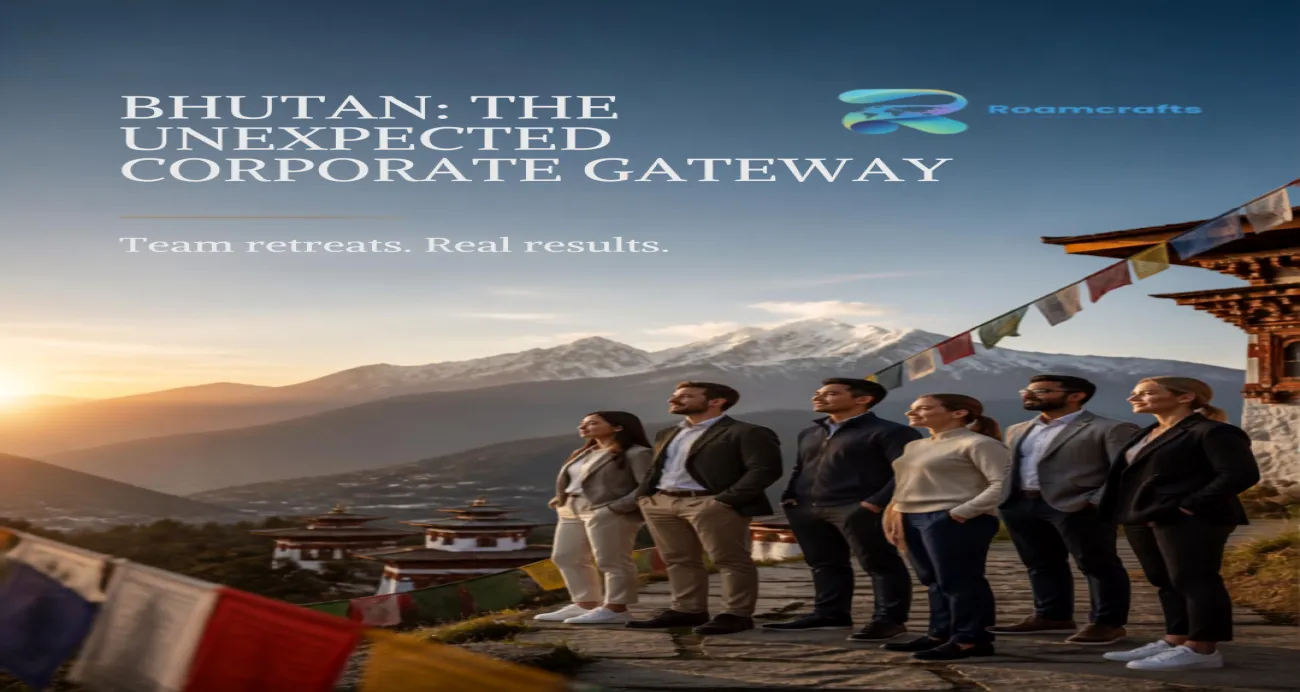
Now imagine this instead. Your team, standing on a mountain ridge. Prayer flags overhead. It is so silent, complete, you can hear your own thoughts. You can feel the transformation within yourself.
That's the whole idea behind corporate travel to Bhutan. And it's catching on fast.
Good question. Bali is beautiful. Dubai is flashy. So why are companies suddenly choosing Bhutan?
Simple. Bhutan doesn't just look different. It feels different.
This is the country that measures Gross National Happiness instead of GDP. Not a marketing gimmick. An actual government policy since the 1970s.
That mindset seeps into everything here. The pace. The silence. The way people actually listen when you talk.
For teams who have back-to-back Zoom calls, you can feel the shift. That shift hits different. Corporate travel to Bhutan isn't just a change of scenery. It's a reset button.
Let's be honest for a second.
Most offsites don't work. Everyone flies somewhere nice. Sits in another conference room. Does the same PowerPoint dance. Then flies home, exhausted, having "bonded" over lukewarm buffet lunches.
Nothing actually changes.
Corporate travel to Bhutan flips that script completely. There's no room for autopilot here. No familiar hotel chain logos. No distractions pulling people back into old habits.
Just mountains, monasteries, and a team forced to actually be present. Turns out, that's exactly what breaks the ice better than any trust-fall exercise ever could.
Picture your team hiking up to Tiger's Nest Monastery together. Sweating. Laughing. Helping each other up the final steep bit.
That shared struggle? It builds trust faster than any icebreaker game.
Or picture a strategy session held in a traditional farmhouse, windows open, mountain air drifting in. You can see how ideas flow more easily if you are no staring at fluorescent lights.
Companies planning corporate travel to Bhutan are building itineraries around exactly this. Half structured meetings. Half real cultural immersion. Archery sessions. Local monastery visits. Evening bonfires where hierarchy quietly disappears.
Nobody's checking their phone during a bonfire in the Himalayas.
Some companies go further. Morning yoga sessions before breakfast meetings. Guided meditation with actual Buddhist monks. Team dinners inside centuries-old dzongs, lit by candlelight instead of LED conference lighting.
It sounds unusual on paper. It works brilliantly in person. Teams stop talking like colleagues reading from a script. They start talking like actual humans again.
Fair concern. Beautiful mountains don't help if logistics are a nightmare.
Turns out, Bhutan makes this surprisingly smooth.
Indian companies get an easy advantage here. No visa required for Indian citizens. Just a passport or voter ID. That's just one less headache on HR's to-do list.
Connecting flights are from Kolkata, Delhi, and Guwahati. Paro has only got an airport. It is set above the mountains; highly dramatic but very efficient.
Hotels include anything from small boutique-esque establishments and luxurious 5* hotels to Conference availability.
The hotels included are so very high standard and a single bit have nothing to envy any other hotels back in the UK! Now, lounges can be cleverly disguised in large valleys that are never walked through by tourists.
So yes. It works logistically. Not some far-fetched adventure fantasy. It's bookable, plannable, and increasingly popular among companies tired of the usual offsite formula.
Here's the part that actually matters to your finance team.
Teams that disconnect properly come back sharper. Not tired-sharper. Actually rested-sharper.
Bhutan strips away every usual distraction. No frantic city traffic. No constant notification pings pulling attention away. Just space to think clearly again.
Leadership teams report better decision-making after these trips. Not because Bhutan has magic mountain air. Simply because stripped-down environments force real conversations instead of scattered ones.
Corporate travel to Bhutan isn't a luxury line item anymore. Smart companies are starting to treat it as an investment in actual output.
Leadership retreats. Annual strategy sessions. Team-building trips after a tough quarter. Reward trips for high-performing teams.
Basically, anyone tired of hotel conference rooms and stale agendas.
Startups love it for the "disconnect and dream big" energy. Larger corporates love it for genuine executive bonding away from office politics.
You get a perspective from this type of trip that a five-star hotel cannot afford to offer.
Every season has its own beauty. But the timing is very important, which the companies are unable to realise
| Season | When | What You Get | Worth Knowing |
| Spring | March – May | Blooming rhododendrons, clear mountain views | Ideal for outdoor sessions and hikes |
| Autumn | September – November | Crisp air, Bhutan's biggest festivals | Time it right, and you'll accidentally plan something unforgettable |
| Monsoon | June – August | Green valleys, but slippery trails | Skip this window if outdoor activities matter to your itinerary |
Is corporate travel to Bhutan expensive?
No, it totally depends upon the number of people and the places where you want to stay. Mid-range corporate packages are surprisingly affordable compared to typical luxury offsite destinations.
Do Indian companies need special permits?
Indian citizens don't need a visa. Some remote areas may require additional permits, easily handled by a local travel partner.
How long should a corporate trip to Bhutan be?
Mostly organisations arrange for 4 to 6 days. You have ample time to rewind, bond and still return refreshed for work.
Is Bhutan good for large teams?
Yes, though smaller to mid-sized groups (15–40 people) tend to have the smoothest experience logistically.
Somewhere between the mountains and the monasteries, teams stop performing for each other and start actually connecting.
That's the real magic behind corporate travel to Bhutan. Not the scenery alone. The shift helped you to think, communicate, and work together.
Your next meeting schedule should not be necessarily a large conference room. It could be a mountain ridge, a shared hike, and a team that actually remembers the trip a year later.
Planning corporate travel takes time you probably don't have.
Roamcrafts builds custom corporate itineraries for Bhutan, permits, stays, transport, and cultural experiences, all handled end-to-end.
You focus on your team. We'll handle the mountains.
Plan Your Corporate Trip to Bhutan With Roamcrafts
MSME certified
UAN:WB010011988